

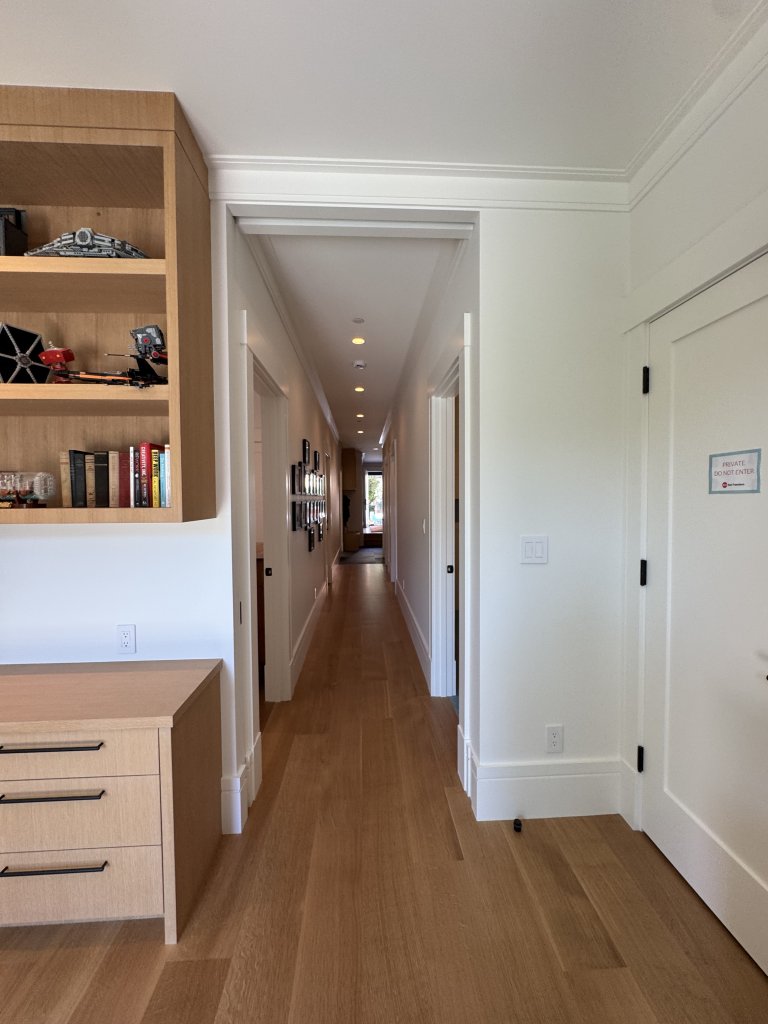
Location: San Francisco, California,
Wood Highlights: Interior door casings made with a custom profile never look wrong
SF Luxury: When Off the Shelf Door Trim Looks Wrong
The retail lumber yard calls it premium interior door trim. It comes wrapped in plastic, primed, and sized for a standard 8-foot ceiling in a standard American subdivision. Then it gets installed in a 1905 Edwardian with 10-foot ceilings, 4-inch-deep window reveals, and door openings that were proportioned for casings nobody mass-produced anymore. The result isn’t premium or luxury, it’s a room that feels completely off. Professional designers, architects, and builders see it immediately. Most homeowners just sense that something is wrong and can’t articulate why.
The key reason comes down to the shadow line. And once you understand what it is, you can’t unsee what’s missing.
The Problem With Premium Interior Door Trim
The word premium on a retail casing means a thicker substrate, a smoother prime coat, maybe a slightly more complex profile than the builder-grade option one shelf below. What it doesn’t mean is that the profile was designed for your building. Off the shelf interior door trim is engineered for volume, standardized widths, standardized depths, and lengths, profiles that read well enough in a showroom but flatten against the scale of a historically proportioned room.
San Francisco’s residential architecture was built with specific proportional relationships between ceiling height, opening width, and trim depth. A Victorian parlor door with a 42-inch-wide opening and 10-foot ceilings demands a casing with proportional reveal depth that creates visual weight. A 2.25-inch retail casing, regardless of how well it’s primed, reads as thin and insubstantial in that context. The Architectural Woodwork Institute defines three quality tiers for millwork — Economy, Custom, and Premium — and the distinction between them centers on tolerance and profile precision, not just the label on the packaging.
What a Shadow Line Actually Is
A shadow line is the visual depth created by the reveals and contours in a moulding profile, the interplay of light and dark across the surface that defines the transition between wall and opening. In a well-proportioned room, the shadow line is what gives interior door trim its architectural presence. It’s not decoration. It’s the visual grammar that tells your eye where the wall ends and the opening begins.
The depth of a shadow line depends on how precisely the profile is cut. A knife ground to 1/32″ tolerance produces crisp edges that hold their definition through multiple coats of paint. A mass-produced profile with soft shoulders, the rounded, imprecise edges that result from high-speed production tooling, loses those edges after the first coat. By the third coat, the shadow line is gone. The trim looks flat.
UNIQUE LOWPENSKY INSIGHTThe Three-Coat ErasureMost off the shelf retail profiles look acceptable at the lumber yard, unfinished, under fluorescent light. What we’ve found across 79 years of milling for San Francisco residences is that profiles ground to 1/32″ hold their shadow line indefinitely. Soft-shouldered retail profiles lose it by the third coat, and that’s the moment “premium” trim starts looking like something from a tract home. |
Why Retail Profiles Disappear Under Paint
Every coat of paint adds approximately 2-4 mils of film thickness to a moulding surface. On a profile with deep, precise reveals, those coats build up without obscuring the geometry, the valleys are deep enough to maintain contrast. On a soft-shouldered profile, those same coats fill the shallow reveals and round the already-imprecise edges until the profile reads as a flat board with vague undulations.
The difference comes down to how the profile was cut in the first place.
This is why the National Park Service preservation standards emphasize profile accuracy when matching historic trim, because the original millwork was cut to tolerances that survive repainting cycles. The knife doesn’t approximate. It cuts to spec. When a profile is ground to the 1/32″ Precision Promise that Lowpensky maintains on every run, the geometry survives decades of maintenance. Retail profiles, produced at volume tolerances, don’t have that margin, and the Custom Gap between what a specifier designed and what actually gets installed widens with every coat.
What Interior Designers Often Specify Instead
The alternative to retail interior door trim isn’t necessarily more expensive, it’s more precise. A custom-run profile from a local mill arrives in one piece, matched to the architectural intent of the room, and is installed in a single pass. No stacking, no shimming, no on-site modification, as many builders report. Schedule and labor costs are thereby reduced. The USDA Forest Products Laboratory research on wood performance confirms that locally acclimated substrates outperform shipped material in dimensional stability, a critical factor in San Francisco’s humidity cycles.
For interior paint-grade work, Poplar is the baseline, stable, dense enough to hold a crisp edge, and far more reliable than MDF in a city where Equilibrium Moisture Content (EMC) acclimation isn’t optional. San Francisco’s EMC sits around 12-14% due to the fog-marine cycle. For stain- grade luxury interior trim, many architects and designers specify Walnut, Cherry, or Mahogany to deliver the visual warmth the room demands, but the profile precision matters as much as the species. At Lowpensky, the team operating the Palou Ave facility and its 650+ LM-Series archive puts it simply: the profile is the architecture, the species is the finish.
How to Evaluate Historic Door Casings Before Ordering
Start with a sample. Remove a section of the existing casing from an inconspicuous location, a closet interior, a secondary room, and bring the physical wood to a mill like Lowpensky that does Forensic Matching. The same applies to thresholds, where the wear pattern and profile geometry are even harder to approximate from a photograph. The paint layers need to come off to find the original wood line, because every historic coat over many decades typically slightly distorts the actual profile.
A mill with an archival reference library can compare the stripped sample against documented historic profiles. Lowpensky’s LM-Series spans 1870 to present, and in a city where building eras overlap block by block, a matching or closely related knife may already exist in the archive. In some cases, that reduces the lead time and cost of a custom grind. In others, especially with older hand-milled profiles, the original geometry needs to be matched directly, since there was often no standardized profile to begin with.
Before committing to a full production run, request a sample run, typically an 8-foot board produced using the actual knife setup. Because it requires a full setup, it carries an associated cost, but it allows the profile to be evaluated in real conditions before proceeding. This step gives customers a way to verify the match in person and reduces the gap between what was specified and what gets installed. The sample board is also usable material, so if the profile is approved, it can be incorporated into the installation rather than wasted.
FAQs About Interior Door Trim
Why does retail off the shelf interior door trim look wrong in many San Francisco homes?
Off the shelf interior door trim is designed for national distribution at standardized scales. San Francisco’s historic homes were built with deeper reveals and taller proportions than modern construction. A retail casing scaled for 8-foot ceilings loses its shadow line in a 10-foot room with historic proportions.
What is a shadow line in moulding?
A shadow line is the visual depth created by the reveals and contours of a moulding profile, the play of light and dark that defines the transition between wall and opening. When a profile is too shallow or soft-shouldered, the shadow line disappears under paint.
How do I match historic door casings in an older San Francisco home?
Remove a sample from an inconspicuous location like a closet interior and bring the physical wood to a mill that does forensic matching. Because much historic moulding was hand milled, there is often no true standardized profile to reference. A mill may have a knife in its archive that is close enough to meet the visual requirements, but in many cases the profile needs to be matched directly from the original. Lowpensky offers this type of forensic matching service.
Is custom interior door trim more expensive than retail?
In total installed cost, custom trim is often competitive with, and in some cases less than, modifying off-the-shelf stock on-site. Builders report that retail casings frequently require additional material and labor, including stacking, shimming, and reworking existing sections to create visual consistency.
When matching existing moulding, many customers report installing only what’s needed. For example, if a room is extended, matching the existing profile allows trim to be added only at the new section. Using off-the-shelf trim often means replacing both the new and existing portions to maintain consistency, increasing both material and labor requirements. Matching an existing profile can also reduce overall material use, which may lower total project cost.
Where can I buy luxury interior trim profiles for doors and thresholds in the San Francisco Bay Area?
Lowpensky Moulding on Palou Ave in historic Bayview-Hunters Point, San Francisco is one of the last custom-run millwork facilities inside city limits. Lowpensky mills door casings, thresholds, and window trim in nearly any commercially available species, grind knives to 1/32″ precision, and work with wood acclimated to San Francisco’s Equilibrium Moisture Content (EMC). Standard board lengths typically range from 8 to 16 lineal feet, with lengths exceeding 20 feet available in select species.
Project photographs are shown for illustrative purposes only. Some projects may include moulding fabricated by Lowpensky; unless expressly noted, material sourcing is unknown.
Further Reading
Explore more from the Lowpensky Resources series:
- The San Francisco Guide to Window and Door Casing
The complete guide covers style, proportion, and performance for window and door casings with notable San Francisco residential buildings. - Presidio Heights: Luxury Walnut & Mahogany Casings
Species selection for stain-grade interiors in one of the city’s most architecturally demanding neighborhoods. - San Francisco Casings Resist Rot in Fog & Salt Air
The exterior counterpart — substrate performance, species selection, and climate acclimation.
Custom Built Door Trim Made to Order
Get it made right at Lowpensky — send us a sample or drawing, and we’ll show you what’s possible with our precision quality work.
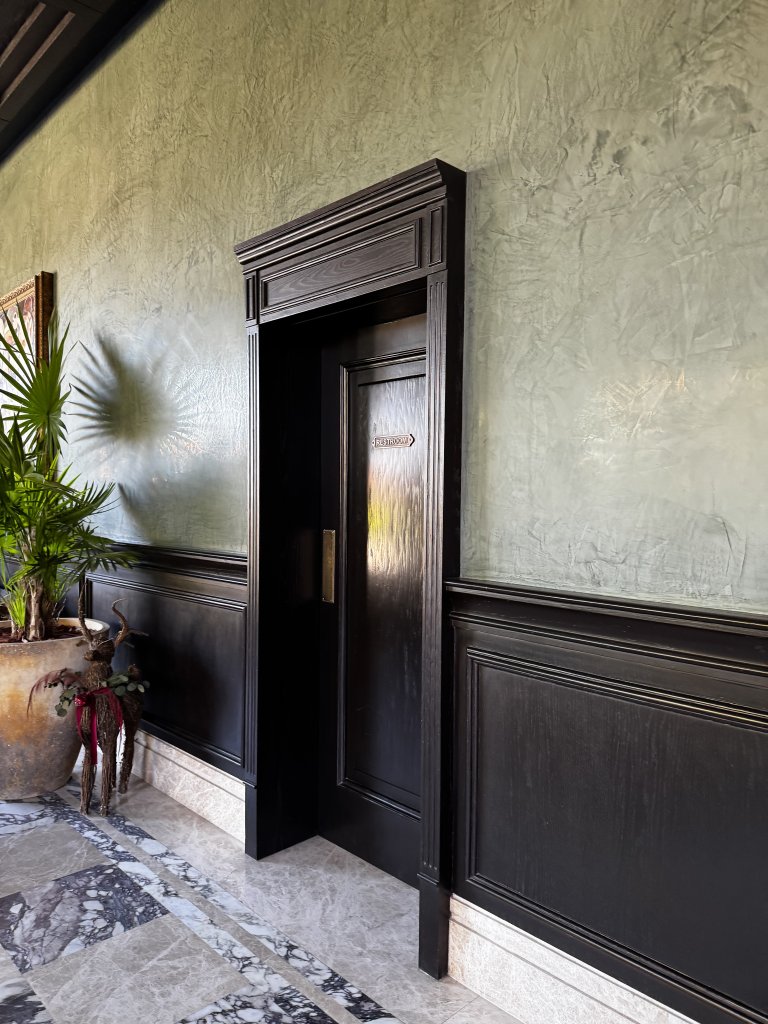
Location: Hospitality project
Wood Highlights: Custom door casings offer proportion and dramatic uniqueness
DISCLAIMER
The information in this article is provided solely for general informational purposes and does not constitute professional, technical, legal, or regulatory advice. Codes, permitting requirements, and construction standards vary by jurisdiction. Consult a licensed architect, engineer, contractor, professional designer, and your local building authorities before beginning any project. Lowpensky Moulding assumes no responsibility or liability for actions taken based on the content of this article.