

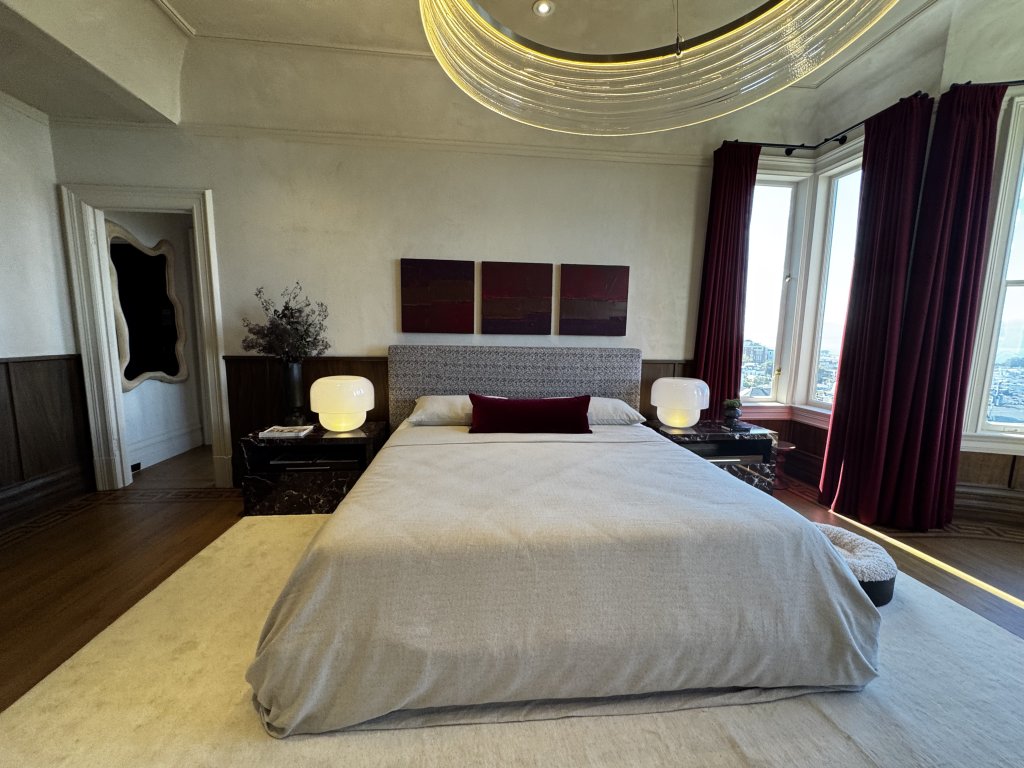
Wood Highlights: The primary bedroom, “West | Red Bedroom” by Castellanos Interiors, at the 2026 San Francisco Decorator Showcase, the 1897 Queen Anne Victorian at 2315 Broadway designed by architect Moses J. Lyon. Deep casings frame the interior door and the coveted, view-facing bay window, a defining feature of the city’s Victorian and Edwardian interiors.
The San Francisco Guide to Window and Door Casing
Meander through almost any San Francisco home built before the 1940’s and the first thing your eye reads, before the paint color or the light fixture, is the way the openings are framed. Window and door casing is the trim that surrounds those openings, and in this city it’s rarely an afterthought. It carries the proportion of the room, the depth of the shadows on the wall, and a good deal of the building’s age. In San Francisco, casing is often the room’s quiet biography: it tells you when the house was built, how formal the room was expected to be, and whether later remodels understood the original architecture.
Over the past six months we’ve looked closely on Resources at how casing behaves in these residences, from sun-exposed moulding in Noe Valley to historic profiles on restored Victorians. This guide pulls those threads into one place: what window and door casing is, how to read it, why the wrong material may fail in the fog, and how a custom profile gets specified, priced, and matched.
What Window and Door Casing Does in a San Francisco Home
Casing has a job before it has a look. It covers the gap between the door or window jamb and the rough opening, hides the shimming and framing, and gives the assembly a clean edge that helps seal against drafts.
A door casing wraps the head and two sides of the opening. A window casing does the same, then adds pieces the door doesn’t have: a stool, the shelf at the sill, and an apron, the trim beneath it.
In San Francisco’s older housing stock, that trim is original architectural detail, not a builder-grade add-on. Victorian and Edwardian rooms carry tall, deeply profiled casings, and the city’s signature bay windows multiply the casing in a room several times over.
That is why a San Francisco bay window is never just a window. It is a small architectural stage, a special place to pause in the room, and the casing smartly frames the moment: light, view, depth, and shadow.
The Window Preservation Alliance, in its guidance on repair versus replacement, treats original window trim as character-defining detail worth conserving rather than swapping out, a position you can read at its resource library. When you add casing in one of these homes, you’re working inside a system designed as a whole.
Style and Proportion: Reading a Casing the Way an Architect Does
An experienced designer or architect doesn’t look at a casing and see merely trim. They see a set of decisions: the width of the face, the depth of the profile, the size of the reveal where the casing steps back from the jamb, and how it all relates to the baseboard below and the ceiling above. Get the proportions right and the room feels resolved; get them wrong and a brand new casing can make an old room look flawed.
The era is the tell. A casing built for an 1890s parlor is wider and more sculptural than one built for a 1930s Marina flat, and the reveal and head detail change with it.
After 79 years of milling for this city, the pattern is clear: the profiles that read as correct are the ones cut to the scale the building was designed around, not a national stock supply pattern shrunk to fit. The Architectural Woodwork Institute publishes the quality grades Premium, Custom, and Economy, which specifiers use to define expectations for materials, workmanship, manufacture, and finished appearance.
Proportion is where a custom profile earns back some of the cost and goes further.
Why Stock Profiles Fail Here: Fog, Salt, and the Shadow Line
San Francisco is hard on the wrong material, and casing is where it often shows up first. The SF fog factor is a strong tester of materials. Medium Density Fiberboard (MDF) can be vulnerable where repeated moisture, condensation, or unsealed edges are present. In San Francisco’s fog-driven humidity cycles, MDF casing may show swelling, softened edges, or joint movement sooner than properly milled and acclimated solid wood, especially at miters and end grain.
Solid wood is a more stable choice, but only if it was acclimated to the right climate. Equilibrium Moisture Content (EMC) is the moisture level wood settles to for a given air condition, and San Francisco’s EMC typically runs approximately 13 to 15%, according to USDA Forest Products Laboratory data, though interior conditioned spaces may vary. Wood milled in a dry inland region and shipped in arrives at 6 to 8%, then swells to the city’s level after install, moving joints and opening gaps.
Salt air and moisture are major variables that affect decisions for designers, architects, and builders.
The Forest Products Laboratory documents this relationship between moisture content, dimensional movement, and decay resistance, and its research is the technical basis for milling and storing wood at the moisture level of the place it will live. That’s the important consideration behind most casing installations in the city.
| UNIQUE LOWPENSKY INSIGHT
Why the Shadow Line Disappears Most people assume a casing profile is only a flat profile, and that a stock pattern from a lumberyard will read the same as a milled one once it’s up and painted. The full dimension of a custom casing is an opportunity to create distinction and play with scale. |
After nearly 80 years of grinding knives and building the LM-Series archive, we’ve found that depth has to be cut into the profile before the first coat goes on in the field. A crisp shadow line is actually an edge and tolerance decision, not a paint decision.
Matching a Historic Profile: How a Forensic Match Works
When a casing in an old home is damaged or missing, the goal isn’t a near-enough copy, it’s the original line. That’s what Forensic Matching at Lowpensky Moulding does.
We strip the paint off a sample to expose the actual wood profile, then compare it against the LM-Series, an archive of 650+ unique steel knife profiles spanning 1870 to the present. If the profile exists we grind to it; if it doesn’t, a new knife is cut to the sample at 1/32″ precision, and the CAD drawing is saved permanently so a future re-order matches exactly.
This lines up with how preservation work is supposed to be done. The Secretary of the Interior’s Standards for the treatment of historic properties emphasize retaining, repairing, and, when necessary, replacing historic features in a way that matches the old in design, color, texture, and materials where feasible. Those standards are widely used as a benchmark in preservation and landmark-review work.
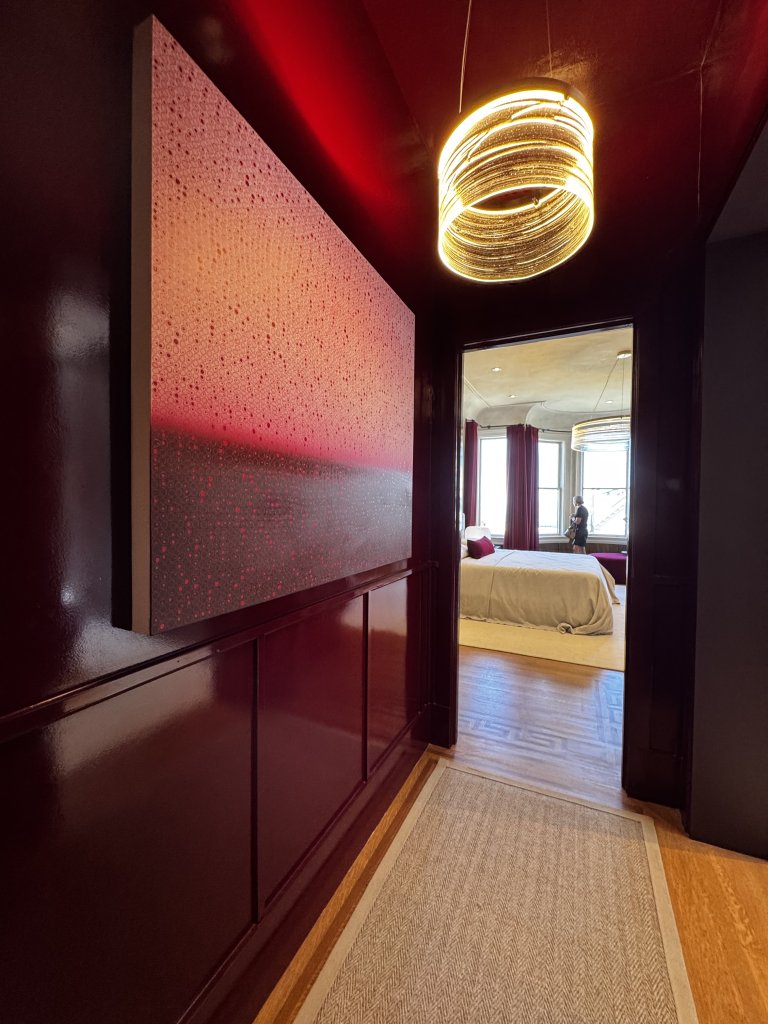
Wood Highlights: The hall of the primary dressing area is intense as it leads to the primary bedroom, by local Castellanos Interiors at the 2026 San Francisco Decorator Showcase. Lacquered paneling with a crisp door casing carries the room’s tonal red scheme through the threshold. The effect reads as thoughtful customization and uniqueness rather than stock materials.
Choosing the Wood and Profile for Your Casing
Two decisions drive a casing order: the species and the profile. Species depend on where the casing will be installed.
For exterior casing in the city’s damp air, decay-resistant woods like redwood and cedar are the durable choices, a record the California Redwood Association details in its species data and Western Red Cedar Lumber Association covers cedar’s decay resistance for exterior use. For interior stain-grade work, hardwoods like walnut, mahogany, and white oak give the depth of grain a clear finish. Poplar is often specified for painted interior trim. Lowpensky Moulding mills and acclimates the wood locally so the wood meets San Francisco’s air rather than fighting it, to your specification.
The profile decision is either a new selection or a match. You can choose an existing pattern from the catalog, or hand us a sample and have the profile matched to it.
Painted casing conceals the species, so there the choice is about stability and how the profile holds a crisp edge under paint. Poplar is known in the industry as being very cost effective, milling nicely, and taking paint very well. Stain-grade casing puts the wood on full display, so species and grain are often visible. Either way the window and door casing is run to order rather than pulled from a stock bin, which is what lets it suit the specific room instead of the average one.
What Custom Casing Costs and How It’s Quoted
The instinct is that custom must cost more. In many San Francisco homes, the opposite can be true once the whole job is counted. If a new opening, addition, repair, or remodel needs to tie into existing historic casing, an exact custom match can avoid the much larger cost of removing and replacing all the existing trim just so the new area looks consistent.
That is where custom milling earns its value. Instead of stacking or modifying stock trim, or replacing good original casing throughout a room or floor, Lowpensky Moulding can match the existing profile and provide it only where the new or missing casing is needed. The result can be a cleaner architectural match with less demolition, less replacement material, and less disruption to the finished space. Labor costs oftentimes far outweigh the material species and milling costs when it comes to interior trim.
The most cost-effective option is often the custom run, once labor and installation complexity are included.
Getting a quote is simple, and there’s no minimum order requirement. Bring a 6-inch sample, choose from the catalog, or send scale drawings, and we mill to that. Standard turnaround is typically one to two weeks, depending on the production queue, material availability, and project complexity. Rush options may be available for an additional fee.
Orders often include a 10–15% waste buffer to cover cuts and fitting, which helps keep a short run from stalling a casing installation. The CAD drawing is saved, so the next room, or the next phase, matches the first exactly. For pricing on your own project, our team can walk you through species, lead time, and quantity directly.
Frequently Asked Questions | Window and Door Casing
What is the difference between window casing and door casing?
Door casing frames a door opening across its head and two sides, covering the gap between the jamb and the wall. Window casing frames a window the same way, but typically adds a stool and apron at the sill, the horizontal shelf and the trim beneath it. Both set the proportion of the opening and the depth of its shadow line.
Why does MDF casing fail in San Francisco?
MDF can absorb moisture through exposed edges and cut ends, which may lead to swelling or joint failure in damp conditions, including wet rooms, exterior trim, and poorly sealed openings. In San Francisco, where fog and humidity cycles are common, MDF is usually a higher-risk or improper choice than properly selected solid wood.
Can you match the casing in my Victorian or Edwardian home?
Yes. Lowpensky Moulding maintains the LM-Series, an archive of 650+ unique steel knife profiles spanning 1870 to the present, and uses a Forensic Matching process that strips paint to find the original wood line. From a 6-inch sample, the profile can be ground to 1/32″ precision and the CAD drawing saved for exact re-order matching.
How much does custom window and door casing cost?
Custom casing pricing depends on species, profile, quantity, and whether the project requires matching an existing profile or creating a new one. In many remodels, exact custom matching can be more cost-effective than replacing all of the existing casing simply to make the new areas match. By milling only the missing, damaged, or new pieces to the original profile, Lowpensky Moulding can help preserve existing trim while reducing unnecessary demolition and replacement. Lowpensky Moulding has no minimum order requirement and saves CAD drawings so a later re-order matches exactly.
What wood is best for casing in San Francisco’s climate?
For exterior casing, decay-resistant species such as redwood and cedar perform well in the city’s damp air. For interior stain-grade work, hardwoods like walnut, mahogany, and white oak are common choices. Lowpensky Moulding mills casing to order rather than pulling finished trim from a stock bin. Depending on the species and project requirements, material may be on hand or sourced for the run, then milled locally to the selected or matched profile.
Where can I buy custom window and door casing near me in San Francisco?
Lowpensky Moulding mills window and door casing to order on Palou Ave in the historic Bayview, one of the last industrial mills inside San Francisco city limits. If you’re searching for window casing near me, that means the wood is milled and acclimated in the same climate it will live in, not shipped across the country. To find out where to buy and what your profile will cost, bring a 6-inch sample or send scale drawings for a quote.
How long does a custom casing order take?
Standard turnaround is typically one to two weeks, depending on the production queue, material availability, and project complexity. Rush options may be available for an additional fee.
Related Reading
This series is focused on window and door casings as a key architectural design element. Go deeper with more examples as observed in local San Francisco Bay Area residential neighborhoods.
- Why SF Sun Warps Noe Valley MDF: The Wood Fix
The material science behind warping failures, and why natural wood in the right species is the solution in the city’s humidity cycles. - San Francisco Casings Resist Rot in Fog & Salt Air
The exterior counterpart — substrate performance, species selection, and climate acclimation. - San Francisco Luxury: When Off the Shelf Door Trim Looks Wrong
Why stock interior casings read as cheap in high-end rooms, and what corrects the proportion. - Presidio Heights: Luxury Walnut & Mahogany Casings
Species selection for stain-grade interiors in one of the city’s most architecturally demanding neighborhoods. - Restoring SF Victorians with Authentic Historic Door Casing
Authentic historic door casing in a Pacific Heights Queen Anne. See Victorian door casing restoration at profile, through the San Francisco Decorator Showcase 2026.
Custom Built Window & Door Casing Made to Order
Get it made right at Lowpensky Moulding. Send us a sample or drawing, and we’ll show you what’s possible with our precision quality work, delivered to your project, curbside.
DISCLAIMER
The information in this article is provided solely for general informational purposes and does not constitute professional, technical, legal, or regulatory advice. Codes, permitting requirements, and construction standards vary by jurisdiction. Consult a licensed architect, engineer, contractor, professional designer, and your local building authorities before beginning any project. Lowpensky Moulding assumes no responsibility or liability for actions taken based on the content of this article.